Mostrando entradas con la etiqueta books. Mostrar todas las entradas
martes, 27 de noviembre de 2018
Book: Amusing Ourselves to Death
You've read 1984, you've read "A Brave New World", you've read "The Information" (you should), you've read McLuhan, and you want more connections between those, Amusing Ourselves to Death. It's like a missing (darker) chapter from "The Information", or an update to "A Brave New World".
Filled with data, and very up to date (being written in 1986). I'd love to see an extension to it talking about the nonsense of information flood and "And now ... this" we're in now. Neil Postman hints at gamification without naming it and speaks with great clarity about the continuous amusement we're in nowadays. Slot machines aren't mentioned in the book, but the fact that now we know many successful platforms/services/soma base engagement on the same algorithms than slot machines makes the book scary when looking at both directions from when it was written. Both as constataion of facts and premonitory.
Here's a very nice review about it, (funnily enough with nice pictures to help the reader)
lunes, 26 de noviembre de 2018
A Philosophy of Software Design
I finished "A Philosophy of Software Design" by John Ousterhout (creator of tcl): https://www.goodreads.com/book/show/39996759-a-philosophy-of-software-design.
The book contains some tips and tricks to keep complexity low, and some concerns against some mainstream trends (agile, short methods, etc..).
The author did a talk (https://www.youtube.com/watch?v=bmSAYlu0NcY) which covers also many of the good points.
Overall the book is a nice conversation starter. It's packed with good advices but it feels a bit short and sometimes simplistic. Maybe it's removing complexity even in the tips, so keeping it "obvious" is part of the magic.
I'm still deciding if it's meta-genius.
lunes, 4 de diciembre de 2017
New-old books for thinking about thinking
So here there are the 4 books I recently got that are keeping me *very* entertained.
Two of them are Lisp-related, and two of them are Hofstadter's.
- The minds I : Short stories from Hofstadter, Dennet, and other sci-fi authors and thinkers. I discovered Stanislaw Lem (author of the story 'The Congress' is inspired on). The whole book is mindblowing. 75% read so far.
- Fluid Concepts and Creative Analogies. Another Hofstadter's book. It goes deep in his view of what AI means, and the different phases where a human brain is creating something from nothing. Example: The sense of 50*10 being "easier" than 74*18: which are the reasons why we find that happening? Can we make machines think in that way also? Is it worth it? 40% read so far.
- Partial Evaluation and Automatic Program Generation: I've been wanting to read that book for ages, and it's free in pdf. The phisical copies are astronomically expensive, but I was lucky enough that my book bot found a copy for 3 euros :). It uses crazy techniques to turn interpreters into compiler generators. Futamura projections are totally mindbending. 20% read so far.
- Building Problem Solvers: A Lisp book on problem solvers. I discovered this techniques in Norvig's PAIP, and also CTM has some parts of Constraint Programming, and I thought that was pretty cool and broad, so I got that one also. The book is written in "pre-common" Lisp, so no CLOS, and *lots* of mutable state, setf-ing function arguments and the like. I'm just starting it, but I think it will be more valuable method-wise than code-wise.
martes, 10 de octubre de 2017
How to Develop a Perfect Memory
Another 'mind hack' book. The original book from Dominic O'Brien (memory champion) where it explains his dominic system and gives tricks and hints on how to apply it to several domains.
It's nice that most of the chapters and tricks use the same core rules, where you have to initially memorize 100 people by their initials, and associate 100 actions to each one of these people. Then you create funny images on a chain of known places using people and the actions.
I've read it and for now I'm only applying to raw memorization of numbers, like phone numbers, credit card numbers and time schedules for buses and trains.
Those techniques are quite useful, and honestly, not hard to use (at least, getting to the "ok plateau"), but I find that this doesn't help much when remembering APIS, or complex entangled fuzzy concepts. Now I'm reading this fuzzy logic, and also I'm continuing "Exploring the world of lucid dreaming", that I started long time ago, in another of my regular rampages of self-hacking I had many years ago.
jueves, 14 de septiembre de 2017
Moonwalking with Einstein
So I finished this one, and I can say it was a nicely put book about the subculture of memory athletes, together with some insights on the most used techniques by themselves to remember insane number of random numbers, or words, or poems.
Long time ago (around 2008) I read an oreilly book called Mind Hacks, which teached some techniques to 'overclock' one's memory, or recall, or mental arithmetic. I remembered the "1 is a bun, 2 is a shoe" placeholders, but here I learned about PAO, the major system and the Dominic System, to be able to remember random numbers (I now know my credit card by heart, after all those years).
I'm now working on my own PAO list (I'm using a mixture of Dominic System and arbitrary associations), and I hope to get to some decent proficency of memorization of numbers and tasks using the technique of loci.
A chapter on Savants, mentioning Brainman (highly recommended), and references to Tony Buzan and random folklore from the 90's make it a very enjoyable fast read.
Overall I liked the book quite a lot, it was fun to read, and I definitely got something from it. I'm afraid none of these techniques used by Memory Athlets will be very useful to retain the kind of information I usually need to remember like programming APIs, data from books (like memorization techniques, heh), or some data that needs to have more context than just a random number.
Anyway, I'm convinced already that the fact that converting things to vivid images and placing them in a memory palace greatly improves recalling.
Next stop, How to develop a perfect memory. And I think that will be enough for this streak of self-improvement.
Long time ago (around 2008) I read an oreilly book called Mind Hacks, which teached some techniques to 'overclock' one's memory, or recall, or mental arithmetic. I remembered the "1 is a bun, 2 is a shoe" placeholders, but here I learned about PAO, the major system and the Dominic System, to be able to remember random numbers (I now know my credit card by heart, after all those years).
I'm now working on my own PAO list (I'm using a mixture of Dominic System and arbitrary associations), and I hope to get to some decent proficency of memorization of numbers and tasks using the technique of loci.
A chapter on Savants, mentioning Brainman (highly recommended), and references to Tony Buzan and random folklore from the 90's make it a very enjoyable fast read.
Overall I liked the book quite a lot, it was fun to read, and I definitely got something from it. I'm afraid none of these techniques used by Memory Athlets will be very useful to retain the kind of information I usually need to remember like programming APIs, data from books (like memorization techniques, heh), or some data that needs to have more context than just a random number.
Anyway, I'm convinced already that the fact that converting things to vivid images and placing them in a memory palace greatly improves recalling.
Next stop, How to develop a perfect memory. And I think that will be enough for this streak of self-improvement.
viernes, 1 de septiembre de 2017
Birds of a feather lisp together
Now that I have some time in my hands (and I already mis Lisp), I'm watching several old Lisp talks, and stumbled upon This event.
On December 3 and 4 of 2004, the Computer Science Department at Indiana University hosted this conference on the occasion of Dan's sixtieth birthday.
Guy Steele's talk is great, as always. Nothing surprising there. Talking about Dan's ideas and Dan itself (and giving a feeling about Dan being isomorphic to what Gilad Bracha says about Luca Cardelli here).
Gerald J Sussman's talk is also very nice, again, as usual.
And all talks I saw have that lispy emotion that we love.
But something that stroke me the most (that after reading 'The information' I realize more) was when Guy Steele talks about the time he read a draft of GEB. It's also a warm fuzzy feeling. Reading GEB leaves some trace in the reader forever. You never read a book the same way, or look at reality in the same way. Same happens with SICP (in process analysis).
Then I realized that in the picture of the event, there are the 3 of them. gls, gjs, and Douglas Hofstadter. Because obviously, they are "friends". And the realization that the authors of my 2 favourite books ever hang around sometimes.
I also remember some Alan Kay talk where he says something like: "a few hours ago I found Guy Steele in a corridor in this event and we talked about blablabla.....". 100% natural :)
Then, while researching a bit for this post, I browsed wikipedia for Hofstadter. And another "proof" that "among certain level of smartness, there's just 1 degree of separation between any two people".
[...]he organized a larger symposium entitled "Spiritual Robots" at Stanford University, in which he moderated a panel consisting of Ray Kurzweil, Hans Moravec, Kevin Kelly, Ralph Merkle, Bill Joy, Frank Drake, John Holland and John Koza.
On December 3 and 4 of 2004, the Computer Science Department at Indiana University hosted this conference on the occasion of Dan's sixtieth birthday.
Guy Steele's talk is great, as always. Nothing surprising there. Talking about Dan's ideas and Dan itself (and giving a feeling about Dan being isomorphic to what Gilad Bracha says about Luca Cardelli here).
Gerald J Sussman's talk is also very nice, again, as usual.
And all talks I saw have that lispy emotion that we love.
But something that stroke me the most (that after reading 'The information' I realize more) was when Guy Steele talks about the time he read a draft of GEB. It's also a warm fuzzy feeling. Reading GEB leaves some trace in the reader forever. You never read a book the same way, or look at reality in the same way. Same happens with SICP (in process analysis).
Then I realized that in the picture of the event, there are the 3 of them. gls, gjs, and Douglas Hofstadter. Because obviously, they are "friends". And the realization that the authors of my 2 favourite books ever hang around sometimes.
I also remember some Alan Kay talk where he says something like: "a few hours ago I found Guy Steele in a corridor in this event and we talked about blablabla.....". 100% natural :)
Then, while researching a bit for this post, I browsed wikipedia for Hofstadter. And another "proof" that "among certain level of smartness, there's just 1 degree of separation between any two people".
[...]he organized a larger symposium entitled "Spiritual Robots" at Stanford University, in which he moderated a panel consisting of Ray Kurzweil, Hans Moravec, Kevin Kelly, Ralph Merkle, Bill Joy, Frank Drake, John Holland and John Koza.
domingo, 13 de agosto de 2017
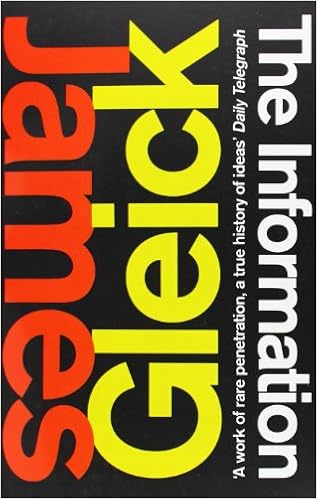
The information
I've just finished one of the books I've enjoyed the most. In my life. "The Information", by James Gleick. I'm totally fascinated by it. maybe because of many references I already knew, and it added contents here and there to a field I'm already into it. I don't know, it's a different beast from purely original content books, as this one is mostly a recap of stories and history, but it's put in a VERY enjoyful way. It burnt my pan twice.
It was a recommendation from Santiago Ortiz, and it was a blast. Filled with insights and anecdotes about how mankind have been treating the information (or the lack of), storing, understanding, using, creating, inventing, discovering.....
I'd say it's a more practical (and up to date) companion for Thomas Khun's "the structure of scientific revolutions". It's nowhere near as revolutionary, but I found it a great source of epistemology.
If you've read CODE by Charles Petzold, I'd say it drives you so a similar steep ramp, but in the abstract side of the same concepts. From simple to complex, from individuality to community, from concrete to abstract, from singularity to commonality. Layers of abstraction get placed one after the other, using bricks filled with dates, names and anecdotes.
It quotes the masters, and it's filled with folklore, which helps you understand what happened when. I truly enjoyed it, and I have tenths of bookmarks inside it, which means I had tenths of AHA! moments. Which unfortunately doesn't happen very often.
Suscribirse a:
Entradas (Atom)